On-device AI
AI models runs directly on your Mac, so your prompts and personal context stay on your device instead of being sent to a cloud LLM.
PUKNO is a private AI memory assistant.
A private home for what you do, see, and discover.
Your digital life has a story. PUKNO remembers what you read, what you did, and how it all connects—turning your digital activity into a memory you can talk to.
Local • Private • Encrypted
Private by design. Local on your Mac. Built around you.
Search the way memory actually works: fragments, places, feelings, topics and half-remembered details.
 PUKNO
I found the trip — and the book you were reading. You saved 18 photos, 4 videos and 7 highlights from the same week.
PUKNO begins on your Mac. Your memory stays close to where it was created, and on-device models can reason over your context without sending your digital life to a remote AI service.
 LOCAL · ENCRYPTED · YOURS
AI models runs directly on your Mac, so your prompts and personal context stay on your device instead of being sent to a cloud LLM.
Your personal data is stored locally on your Mac and encrypted, keeping your memory private and under your control.
Today, your context does not leave your Mac. Future sync will use end-to-end encryption so it can travel securely between your devices.
Your personal context exists to help you — not to become a behavioral profile for ads or third-party targeting.
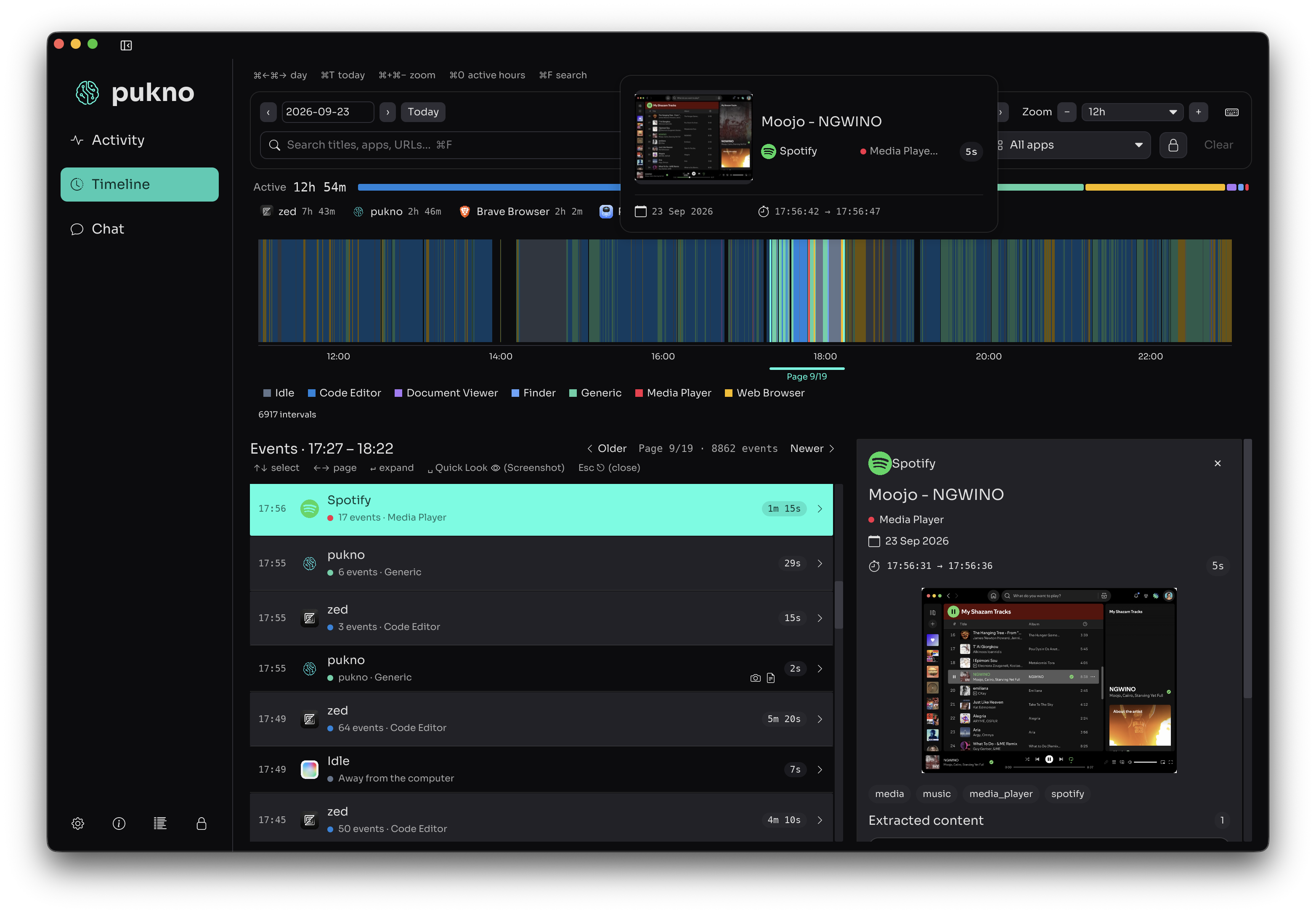
Your day moves between apps, websites, documents and music. PUKNO brings that activity into a private timeline on your Mac, with memory search and chat that help you find what you remember and return to its context.
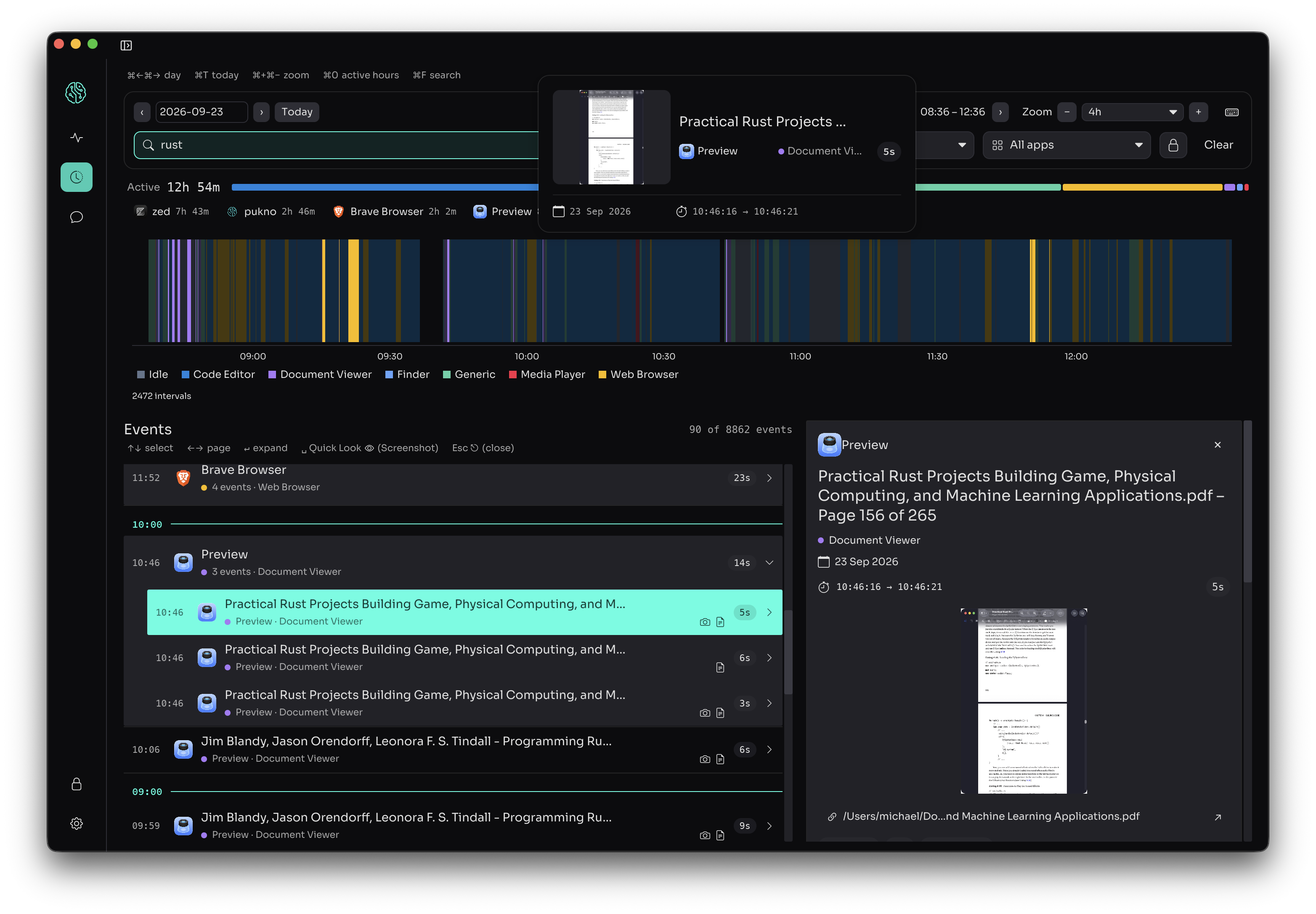
Start with your activity dashboard, explore your day, narrow the search and open a captured moment in Quick Look. Search your captured screens by topic, or ask chat to retrieve a moment from your activity history.
PUKNO Memory connects your captured activity to search and chat. Search by topic or describe what you remember, then ask PUKNO to retrieve the relevant moments and their context — even when you only remember part of them.
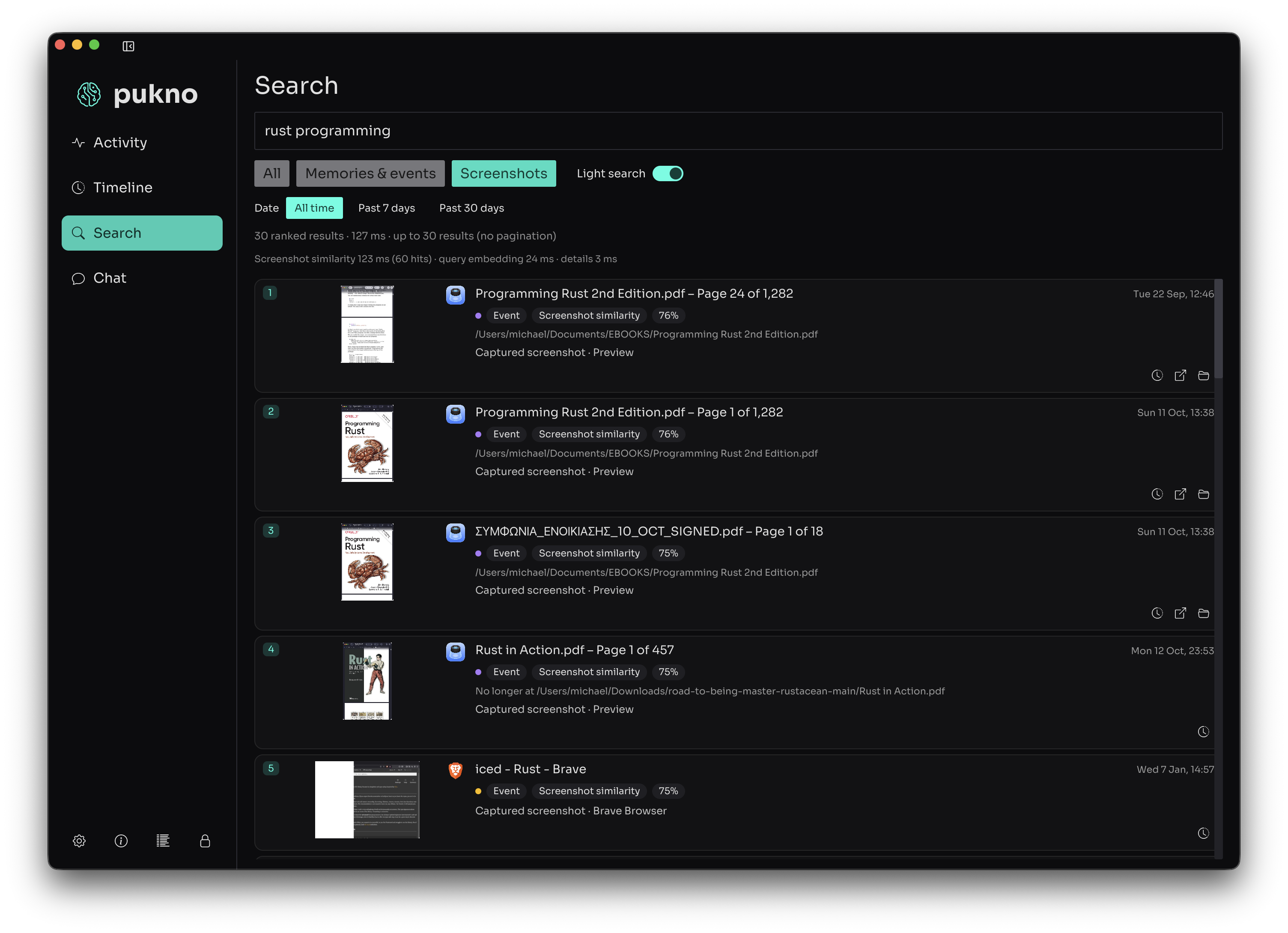
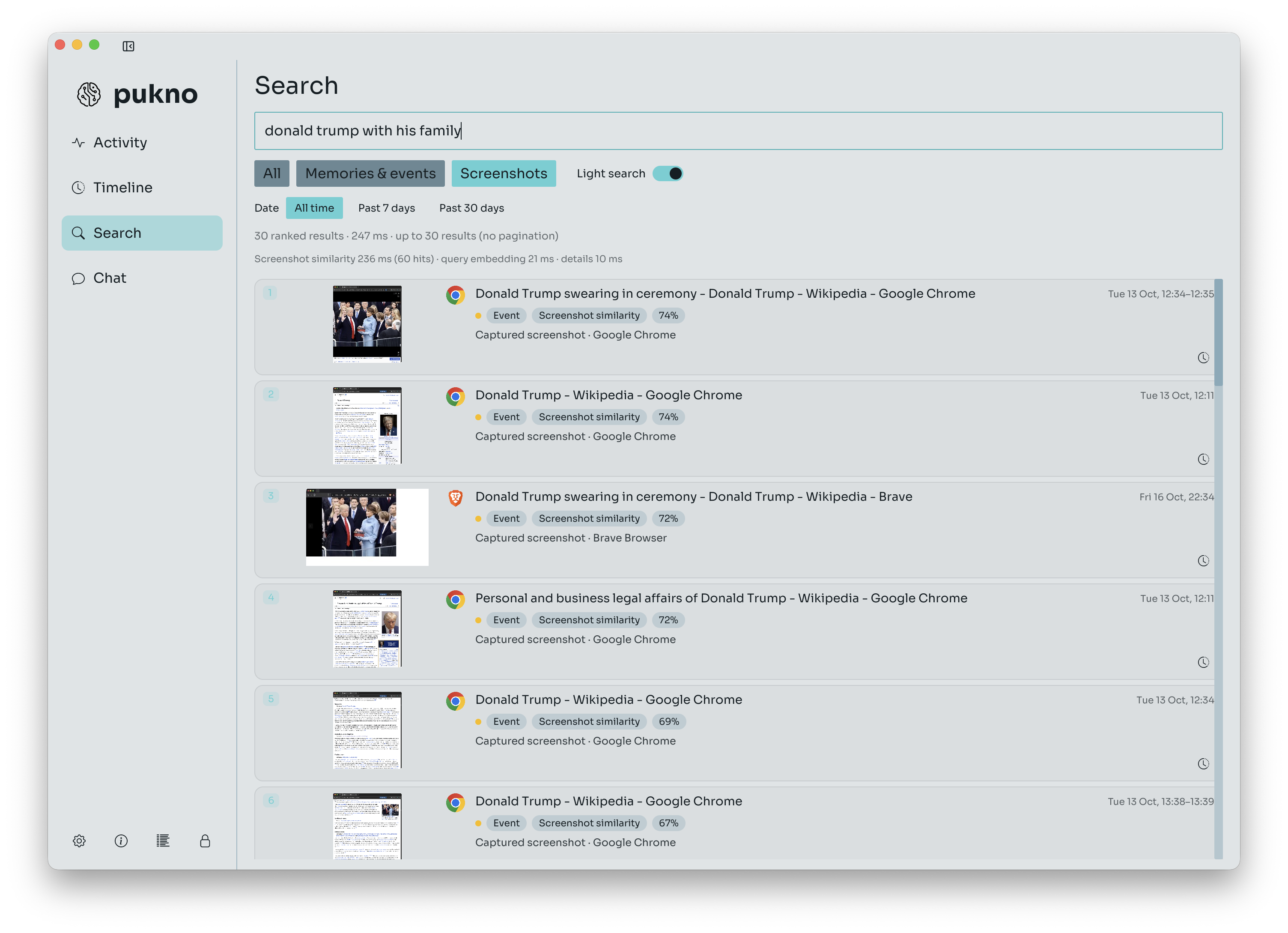
Find captured screens by topic, with ranked results and previews that help you recognize the right moment. Refine your description to narrow the search.
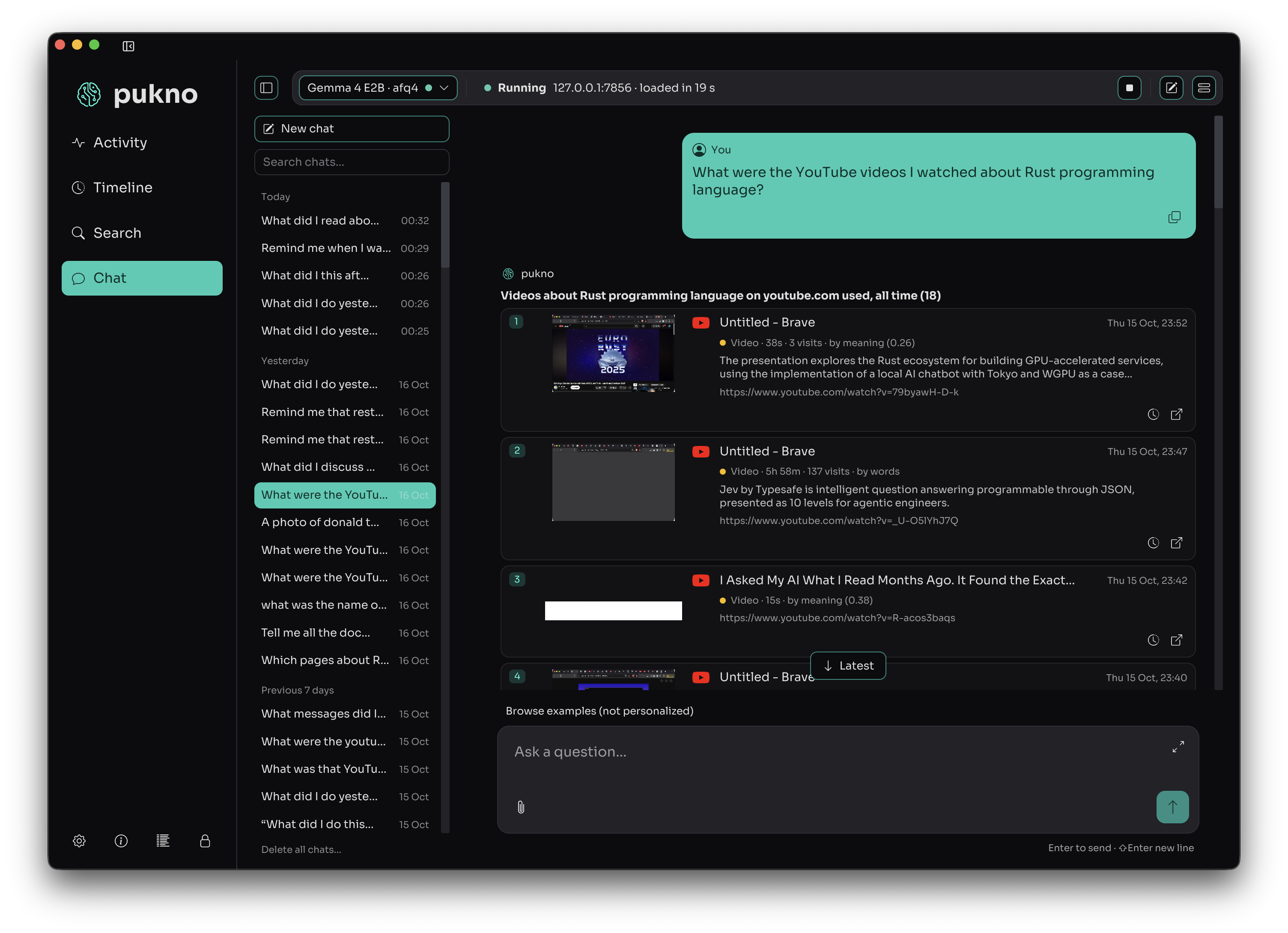
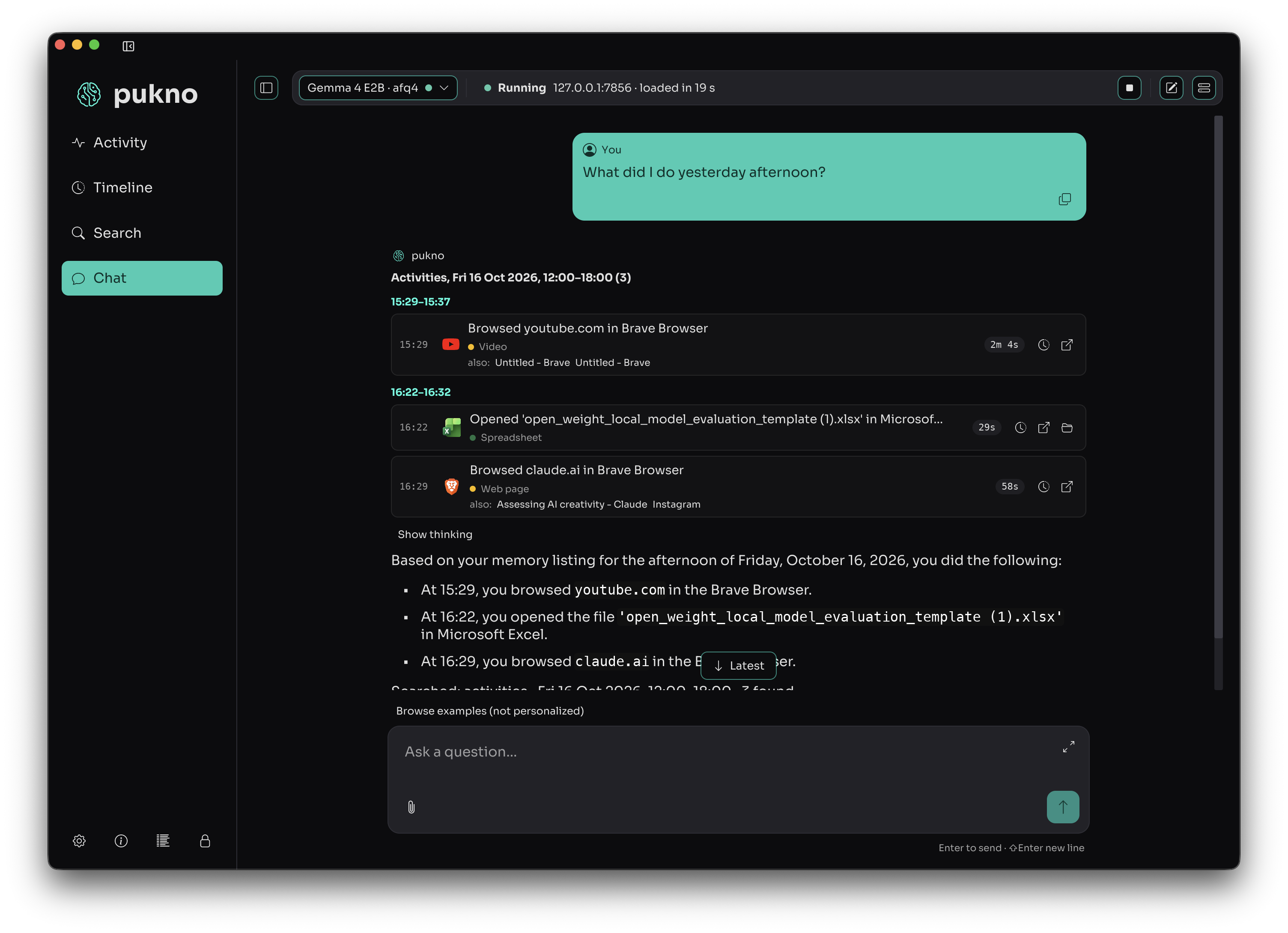
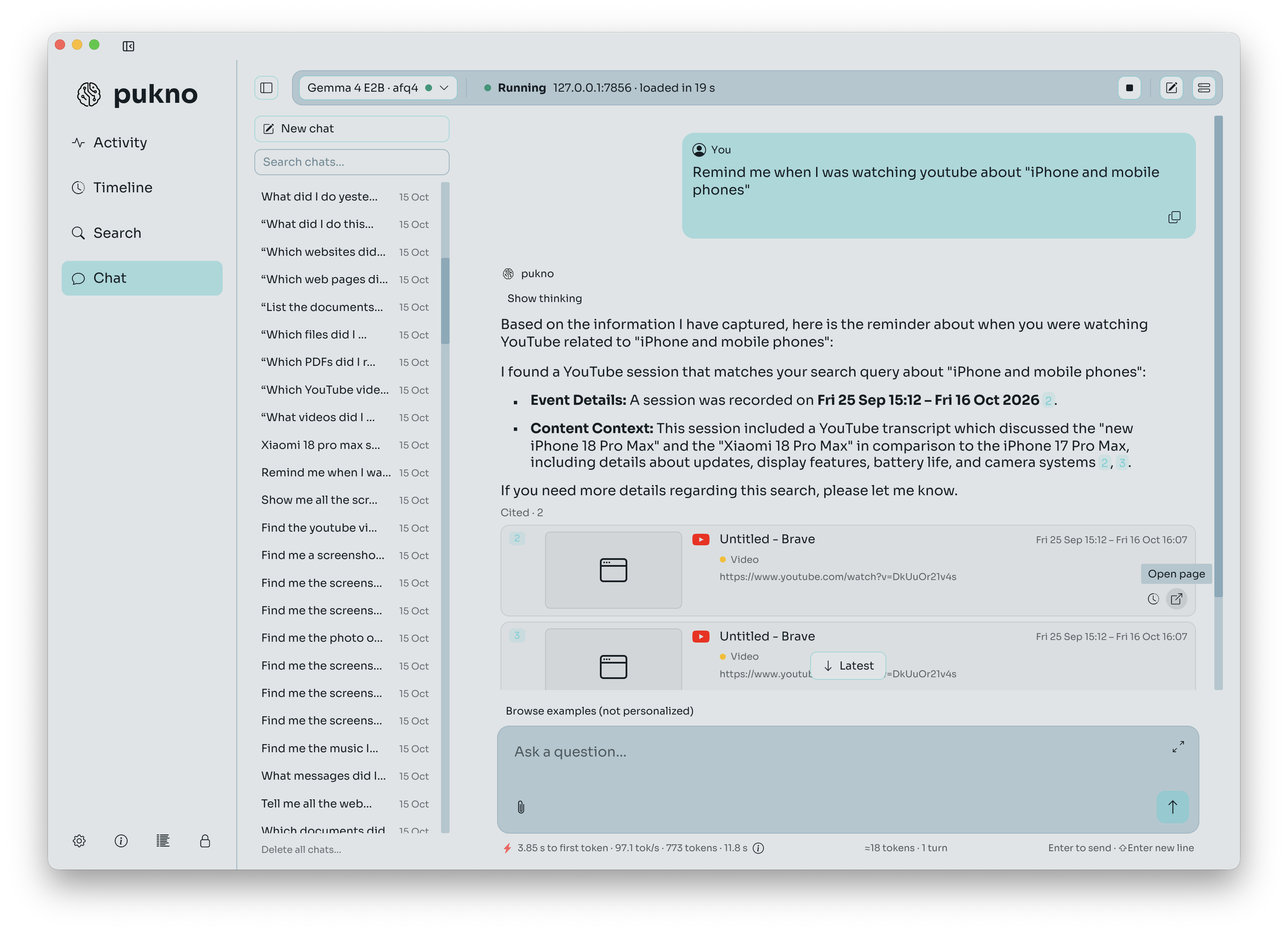
Ask which videos you watched about a topic. PUKNO retrieves matching activity in chat, with source cards that bring the answer back to its context.
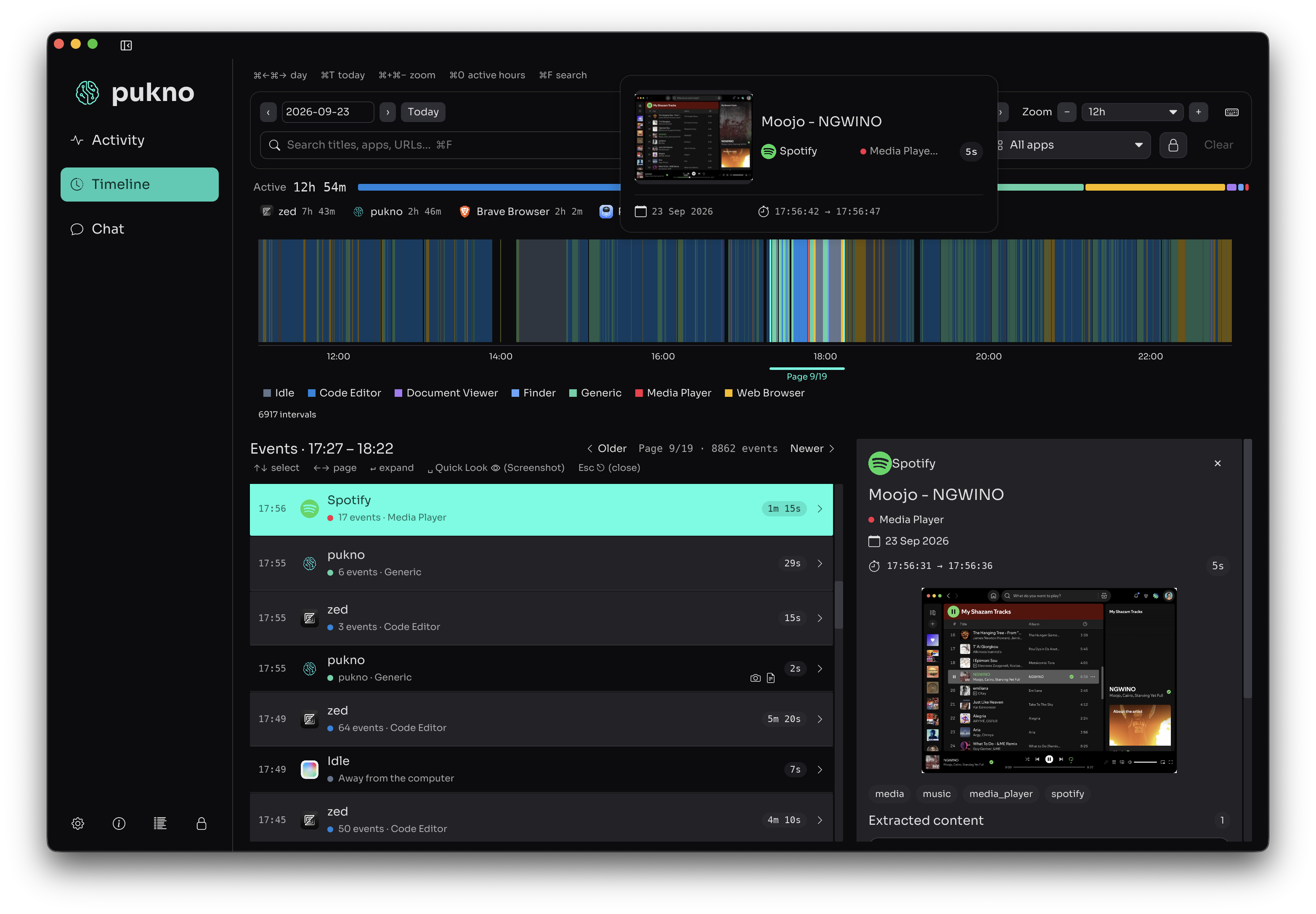
Browse a chronological history of your activity with application and session context attached.
Search and filter by application, activity type, date or session to return to the context you need.
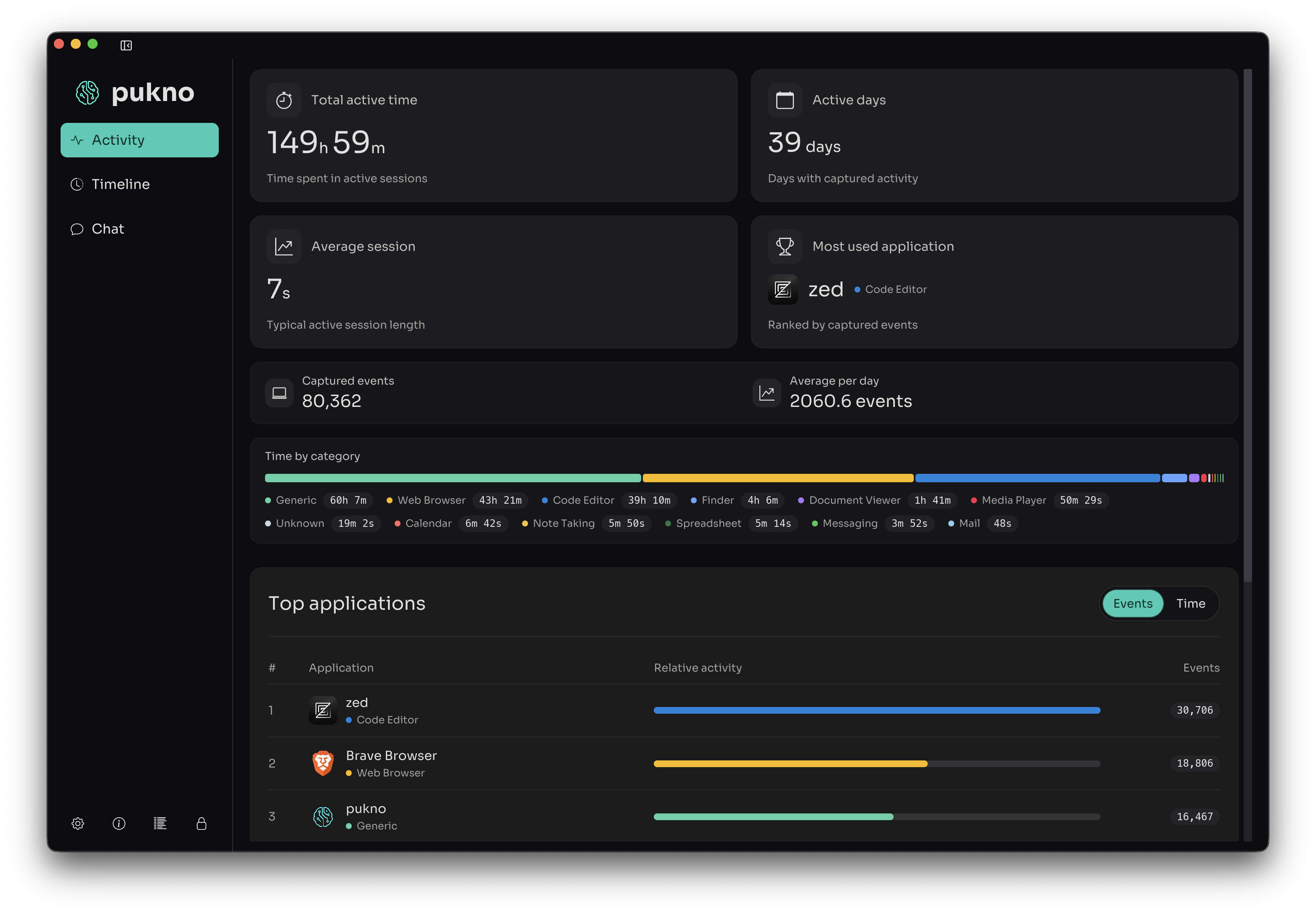
Understand your activity at a glance: total events, active time, average sessions and the applications you use most.
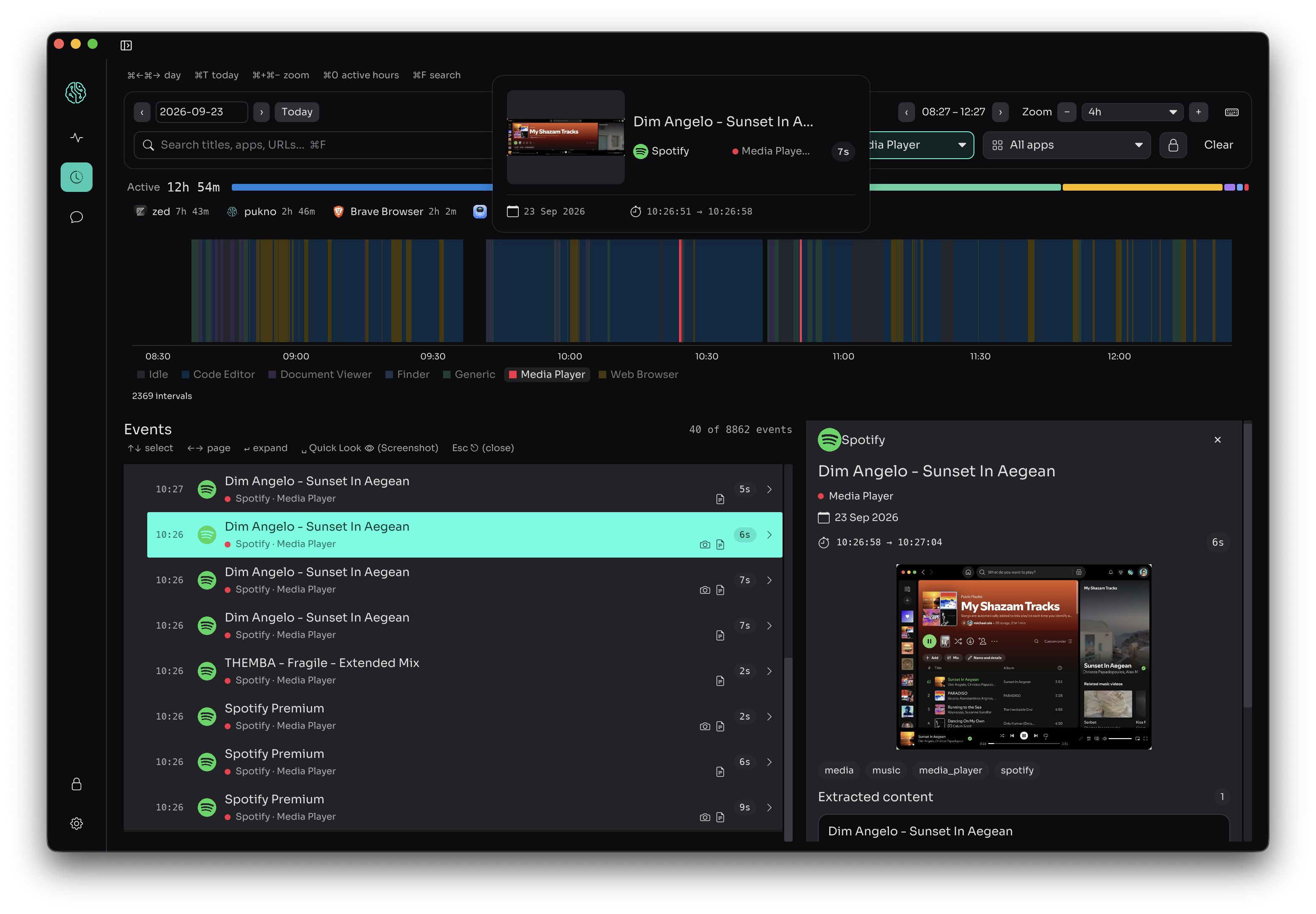
Move from the shape of your day to a specific event. Its title, application, timestamps and preview help you place the moment.
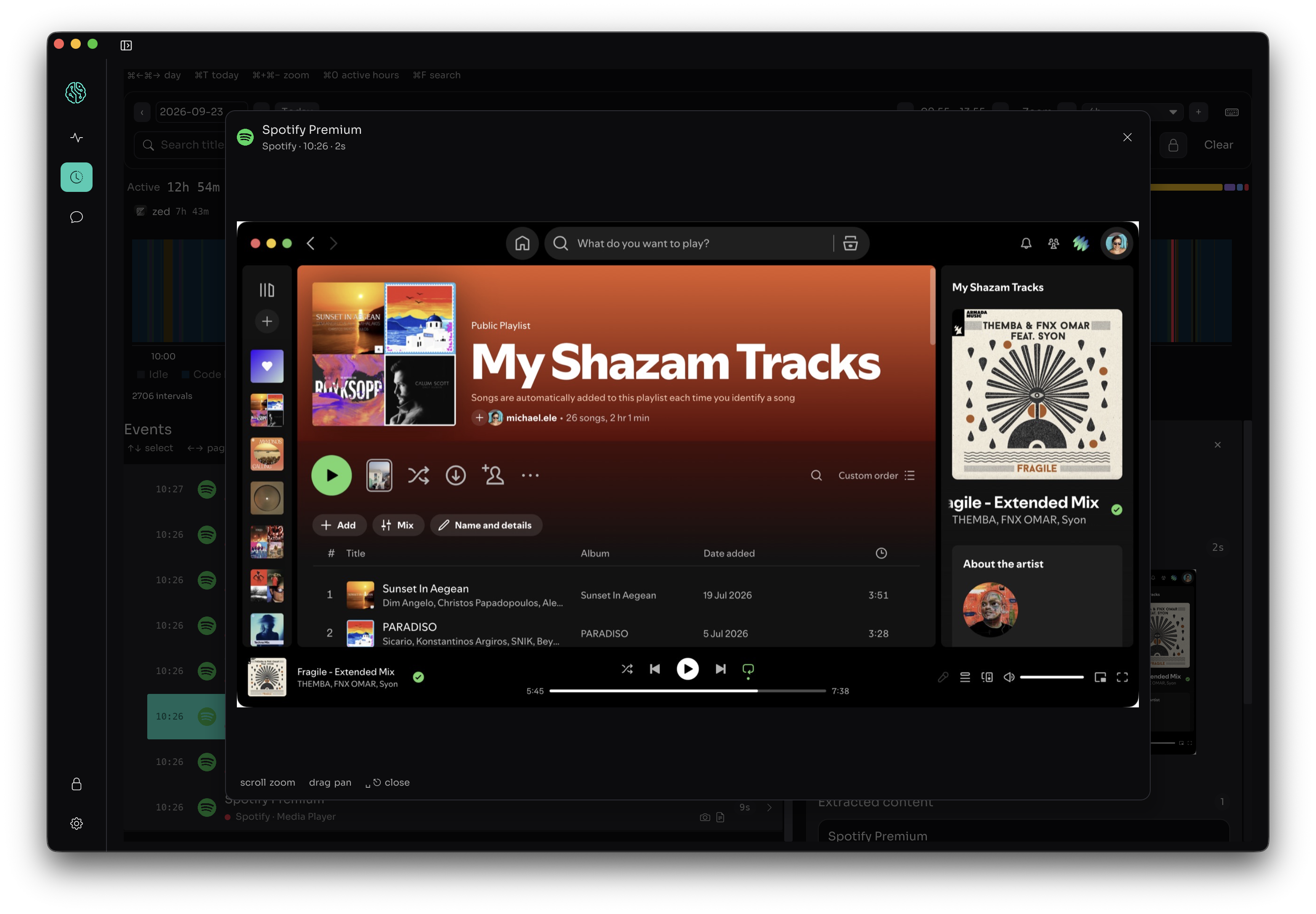
Open a captured screenshot in Quick Look to see the screen behind an event, not just its place in a list.
Choose a local model and ask about your captured activity. Integrated memory brings relevant moments into chat, alongside your conversation history.
Your activity, connected into memory. PUKNO brings your timeline, search, captured context and local AI chat together with semantic memory that connects the knowledge, media and ideas across your digital life — helping you recall moments and explore the connections between them.
PUKNO starts on Mac. Future versions are designed to bring your personal context to iPhone through end-to-end encrypted sync — so what you capture in one place can help you somewhere else.
PUKNO Sync is intended to keep your memory and personal context available on your authorized devices using end-to-end encryption, while the synchronization layer moves encrypted data without needing to understand it.
Requests run entirely on your device by default. In the future, more demanding tasks may use larger models inside protected confidential-computing environments — but only with your explicit consent and according to settings you control. Your personal context remains private, even when the model is remote.
PUKNO Agents are intended to retrieve the context relevant to your goal, choose the tools needed and carry out multiple steps across your computer, apps and connected services — always on your behalf.
How PUKNO works today, where personal memory is going and how we're thinking about privacy along the way.
PUKNO begins by remembering the activity across your Mac — what apps you used, what you were working on and when it happened. It turns that activity into a searchable timeline that helps you return to things you may no longer remember exactly.
Yes. Today, PUKNO runs and processes your activity locally on your Mac. Core activity capture, history and local recall can work without sending your personal context to a remote AI service.
In future versions, you may optionally connect PUKNO to your own AI workstation or use PUKNO Private Compute for tasks that benefit from more powerful models.
PBy default, PUKNO is local-first. Your activity history, memory and personal context are designed to remain on your devices.
Future capabilities such as PUKNO Sync and PUKNO Private Compute are being designed to extend what PUKNO can do without giving PUKNO unrestricted access to your personal data. Remote processing would only happen when required for a feature you choose to use and under the privacy controls designed for that service.
Not yet. PUKNO is starting with memory, context and reasoning. Future PUKNO Agents are intended to go beyond answering questions by understanding what you want to accomplish, choosing the tools they need and carrying out the steps for you.
That could mean finding information you saw before, working with files, navigating apps, creating calendar events, sending messages or completing multi-step tasks across your Mac and connected services.
The difference is context: PUKNO Agents are intended to act using the personal memory PUKNO has already built, so you can ask things like “Book the hotel I was looking at last week” without having to explain everything again.
macOS
PUKNO is currently being built for macOS, with the first releases focused on Apple silicon
Macs.
The macOS version is the primary development target and the first platform where PUKNO's
activity
capture, local context and memory features are being developed.
Windows
Windows support is planned. PUKNO will use native Windows system and accessibility APIs to
understand
which applications, windows and workflows you're interacting with, allowing it to build the
same kind
of private activity context and personal memory available on macOS.
Linux
Linux support is also planned, with desktop-specific integrations rather than a single
generic
implementation. Initial targets include GNOME and COSMIC Desktop, with support shaped around
the
APIs and security model exposed by each desktop environment and compositor.
Across every platform, the goal is the same: capture only the activity signals needed to build your personal context and PUKNO Memory while respecting the security, privacy and permission model of each operating system.
PUKNO Activity Capture
PUKNO currently captures and organizes activity from your Mac — including the apps
you use, application
and window context, sessions, timestamps and supported web activity. This creates a
private activity
history of what you were doing and when, which PUKNO Memory uses for search and chat.
PUKNO Memory
Memory is integrated into search and chat. Search captured screenshots by topic,
ask about activity you remember, and retrieve relevant moments with their context
and source cards — including videos you watched.
PUKNO Sync
PUKNO Sync is intended to make your memory, context and personal intelligence
available across your devices
while keeping that information private. Your activity, memories and personal context
would be protected with
end-to-end encryption so that only your authorized devices can access them.
The synchronization layer is intended to move encrypted data, not understand it. Future PUKNO's sync should not need access to the readable contents of your memory for your devices to stay synchronized and continue building the same personal context.
PUKNO Private Compute
PUKNO is designed to keep personal context and AI processing local whenever
possible. Some requests, however,
may benefit from models that are too large or computationally demanding to run
efficiently on your device.
PUKNO Private Compute is intended to provide a privacy-preserving path to that additional computing power. When you explicitly approve a request, PUKNO could prepare only the context required for that task and send it to an isolated confidential-compute environment running a more capable model.
The goal is to give PUKNO access to powerful remote inference when needed without exposing your broader personal memory to the infrastructure providing that compute.
This could eventually be provided through PUKNO-operated infrastructure or compatible confidential-compute services. It would be invoked only when needed, only with your explicit consent and always under your control. Only the context required for the task you approve would be sent. Data would be encrypted in transit and at rest and processed only inside the protected compute environment.
PUKNO Agents
PUKNO Agents are intended to turn memory, context and reasoning into action. An
agent could understand what you
want to accomplish, retrieve the relevant personal context, decide which tools are
needed and carry out multiple
steps across your computer, apps and connected services.
Instead of only answering “What hotel was I looking at?”, a PUKNO Agent could eventually understand “Book the hotel I was looking at last week,” recover the relevant memory, identify the hotel you meant, choose the appropriate tools and complete the task on your behalf.
PUKNO comes from “Personalized Universal KNOwledge” — the idea of building private personal intelligence from what you've seen, learned, explored and created over time.
PUKNO remembers the context of your digital life — helping you understand what came before and act on what matters next.
Get early access